
Case Study •
Rent Gouging: Check and Report
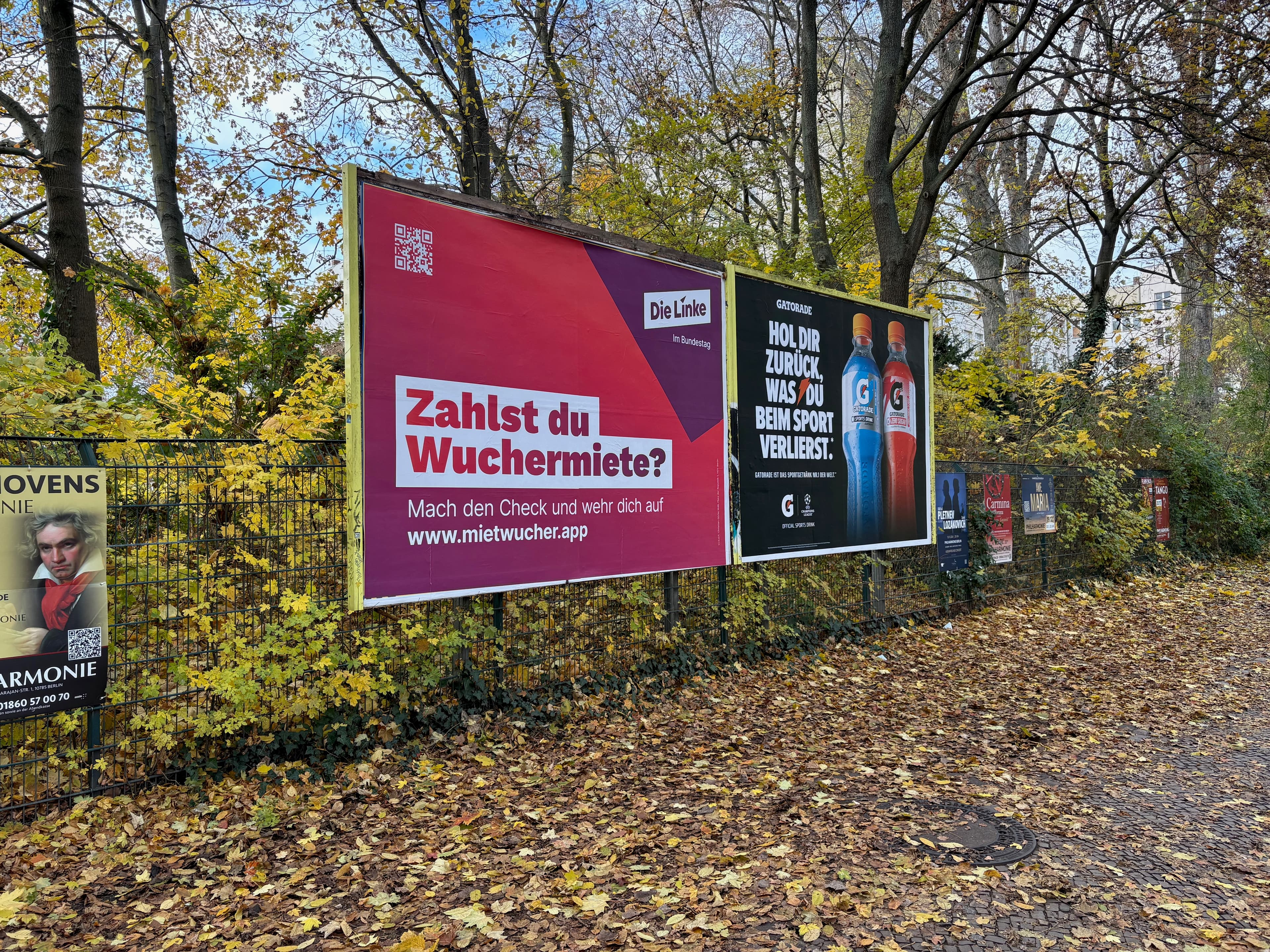
November 2023: The German coalition government collapsed and politics shifted overnight into election campaign mode. Die Linke (The Left Party) in the Bundestag seized on the issue of rent. A large proportion of people in Germany rent their homes and are struggling against skyrocketing rental prices.
Attempts to address the rental crisis — such as the rent brake (Mietpreisbremse) — have not been sufficient to curb rent increases. Only 2 percent of tenants actually make use of the rent brake. The reasons include the complicated calculation involved and the direct confrontation with the landlord, which many tenants are reluctant to face.
In addition to the rent brake, however, the prohibition of rent gouging also applies in certain cases, which can even have criminal relevance: if the rent is 20 or even 50% above the local comparative rent, it may constitute an administrative offense or even a criminal act.
During the election campaign, over 90,000 users completed the Rent Gouging Check — a clear sign that many tenants want to fight back against excessive rents. And this has not been without consequences: nearly 3,300 reports were sent directly to the responsible housing authorities to flag overpriced rents.
Project Goal
With a rent gouging calculator, Die Linke in the Bundestag aimed to provide tenants with a simple tool that identifies rent gouging in numerous cities based on the local comparative rent. In the next step, users should be able to report a potential violation directly to the responsible housing authority.
Challenges & Solutions
The basis for identifying rent gouging is the so-called local comparative rent, which can be determined using the rent index (Mietspiegel). The exact calculation of the rent index is left to the individual cities.
This results in a wide variety of different calculation methods and housing quality criteria used to assess apartment quality. The input form therefore needs to be flexible enough to accommodate these variations. Additionally, there are often conditional questions or answer options that should be dynamically shown or hidden depending on previous inputs.
In addition to housing quality criteria, residential location data often feeds into the determination of the local comparative rent. The residential location is determined based on the address. Here too, there are significant differences in data format and availability.
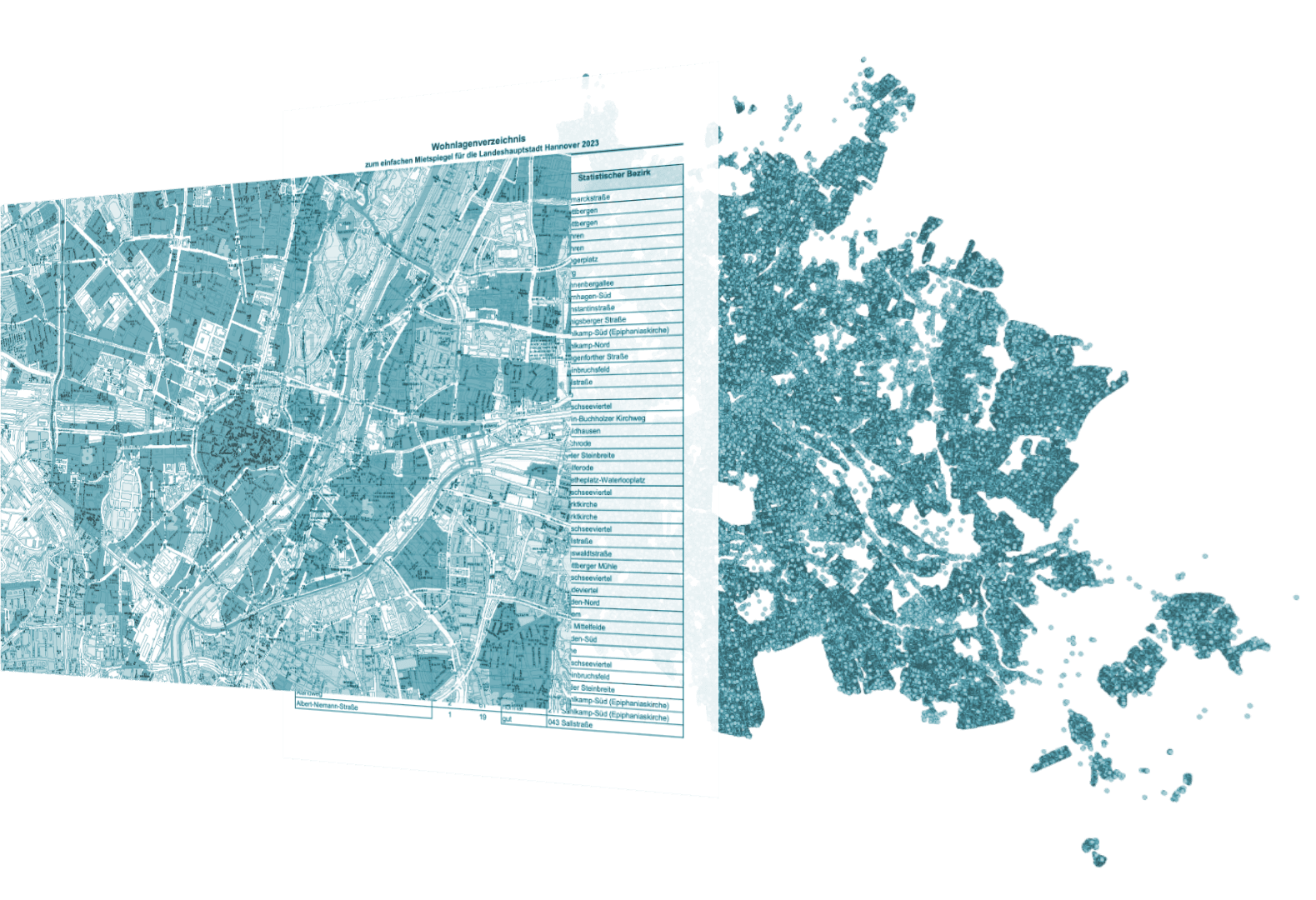
Cities like Berlin, Hamburg, or Leipzig provide residential location data as address-level geo-features.
Freiburg offers two separate datasets: one with geo-features containing address data and coordinates for all addresses in the city, and one with the geometries of the residential location classes. These datasets can be linked through a geographic join, allowing each address to be assigned its corresponding residential location.
In Hannover, the residential location data is provided exclusively as a street directory in PDF format. To use this data, the PDF must first be converted into a machine-readable format. The house numbers including suffixes are then converted into decimal numbers (e.g., 8C → 8.03, 61K → 61.11). This approach facilitates the comparison of house numbers and enables a simple check of whether a specific house number falls within a particular block.
In Munich, the residential location data is provided exclusively as a raster WFS layer. Users must first select their address, after which the WFS layer is centered on the corresponding coordinates. They then determine their residential location themselves by identifying the coloring at their address.
Kassel, in turn, publishes the residential location data as a map in the city's own geoportal, using an ArcGIS Server. While the city of Kassel does not document the automated querying of the data, the ArcGIS Server does allow the data to be output as GeoJSON. The results are paginated and must be merged. In a subsequent step, the address field is split into street, house number, and house number suffix using regular expressions.